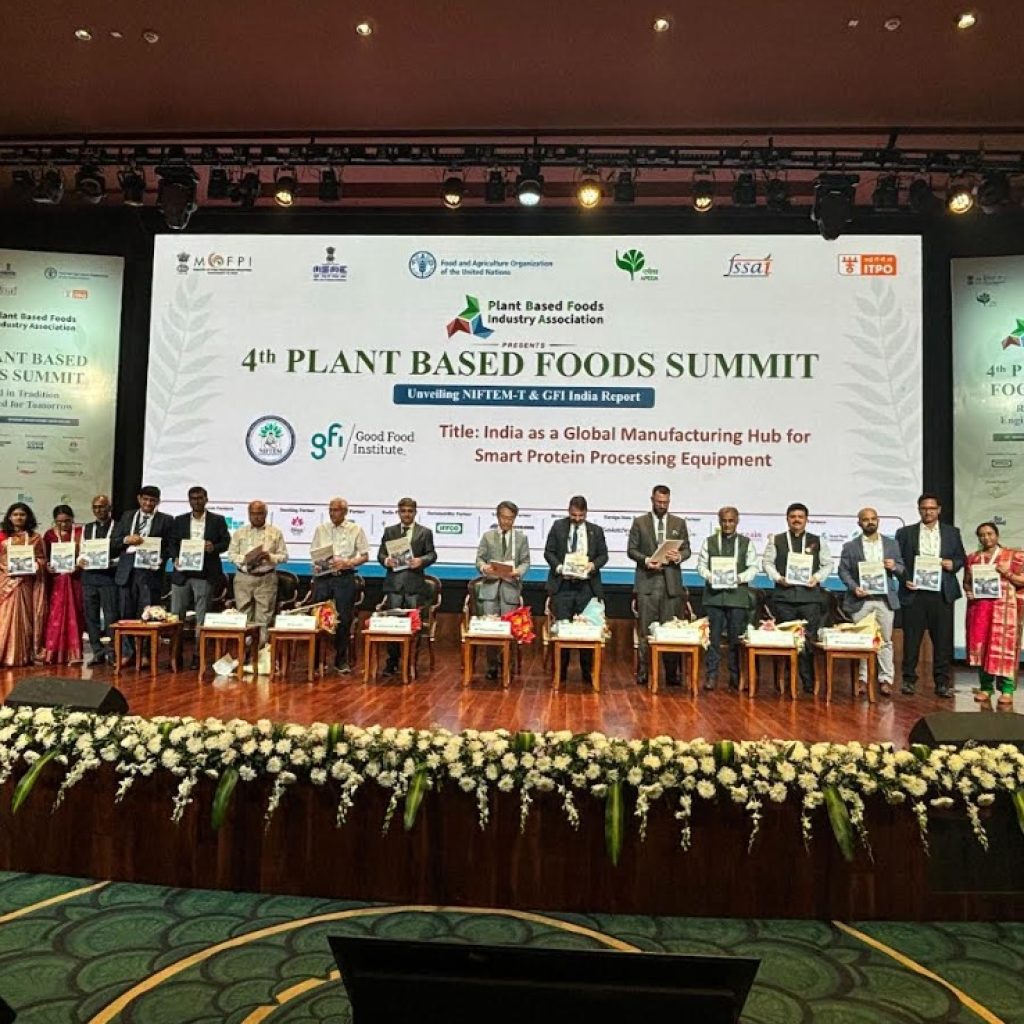
The Good Food Institute India (GFI India), in collaboration with the National Institute of Food Technology, Entrepreneurship and Management, Thanjavur (NIFTEM-T), released a landmark study titled India as a global manufacturing hub for smart protein processing equipment at the 4th Plant Based Foods Summit held on the sidelines of AAHAR 2026. This first-of-its-kind report delivers a comprehensive assessment of India’s current manufacturing capabilities for plant-based smart protein processing equipment, offering strategic recommendations for government, industry, and research institutions to accelerate domestic production and reduce costly import dependence.
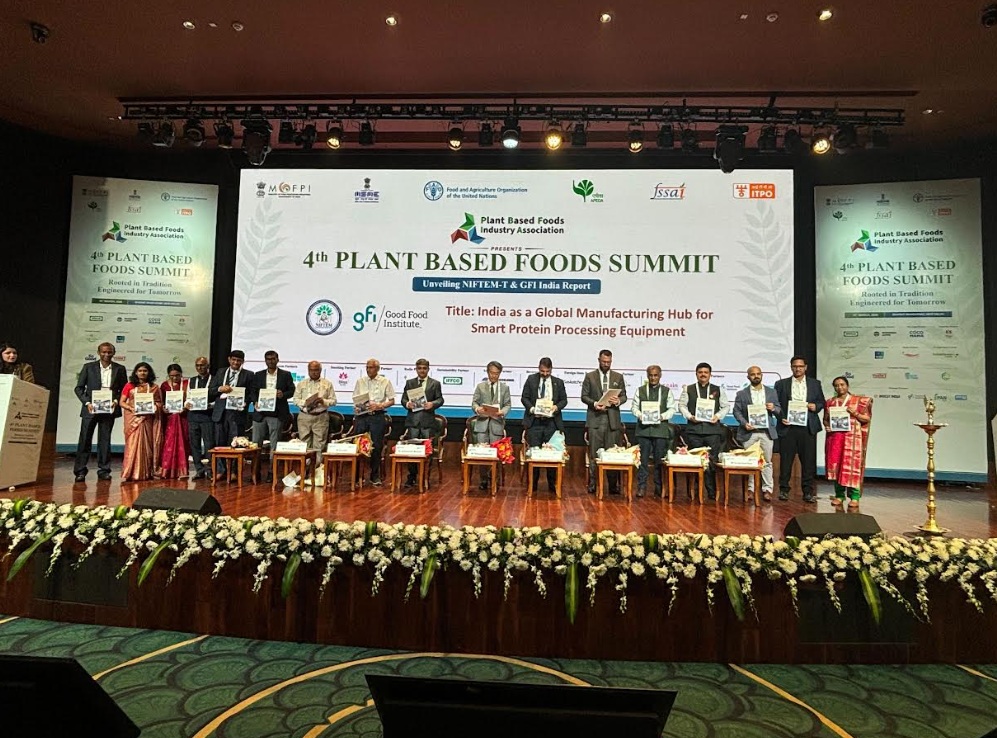 |
GFI and NIFTEM-T launch report on India as a Global Manufacturing Hub for Smart Protein Processing Equipment at AAHAR 2026
The study, led by NIFTEM-T, with valuable contributions from a broad range of academic experts and industry stakeholders in equipment manufacturing, process engineering, and food and agri-processing domains, examines three critical equipment categories at the heart of the plant-based smart protein supply chain: extruders, dryers, and separators. As demand for sustainable protein sources grows, these specialised processing systems are essential for extracting plant protein concentrates and isolates to produce plant-based meat, dairy, eggs, and seafood, among other high-protein plant foods.
According to the report, India imported approximately USD 1.6 billion worth of centrifuges and filtration equipment in 2024–25, while exports stood at just over USD 1 billion, highlighting a significant opportunity to strengthen domestic manufacturing capacity and reduce reliance on foreign suppliers.
The report also highlights technical gaps across key processing technologies such as high-moisture extrusion, drying, and separation systems, which are critical for scaling plant-based meat and other alternative protein products. Addressing these gaps will require investment in shared R&D infrastructure, testing facilities, and technical skill development.
Key Findings:
-
India has 150–200 OEMs in these equipment categories that are cost-competitive and mechanically robust but lack the capability for high-performance, precision manufacturing at scale.
-
Domestic extruders fall short on key performance metrics, such as screw speeds and torque, limiting their use for advanced plant-based meat applications.
-
India has no indigenous manufacturers of food-grade ultrafiltration membranes, as high-end freeze dryers and centrifuges remain almost entirely imported.
-
Priority export opportunities exist in Russia, Southeast Asia, the Middle East, and African markets, where India’s price-performance ratio is a competitive advantage.
Dr. Padma Ishwarya S., Senior Scientist (Plant-based), GFI India, adds, “Smart protein innovation depends not only on novel ingredients but also on the sophisticated processing technologies that transform them into consumer-ready foods. Through academia and industry collaboration and By investing in R&D infrastructure and equipment testing facilities, India can develop high-performance food-grade processing equipment that serves both domestic manufacturers and global markets.”
The report recommends recognising smart protein equipment as strategic capital goods under Make in India, establishing cluster-based shared manufacturing infrastructure, aligning Indian standards with international norms, and creating dedicated R&D funding pathways for the sector.
Prof. V. Palanimuthu, Director, NIFTEM, Thanjavur, commented, “This report provides a roadmap for strengthening India’s smart protein processing equipment ecosystem by identifying critical technological gaps and opportunities. The insights presented will guide policymakers, industry, and researchers in propelling India toward becoming a global hub for plant-based protein equipment manufacturing. I congratulate the teams from NIFTEM-T and GFI India for their commendable joint efforts in refining and analysing all the data on state-of-the-art facilities and developing actionable recommendations that can significantly accelerate the alternative protein sector.”
The launch of the report in the presence of Takayuki Hagiwara, Food and Agriculture Organisation (FAO) Representative in India, representatives from the Ministry of Health and Family Welfare, and representatives from the governments of Germany and Saskatchewan, among other key dignitaries, was a key highlight of the 4th Plant Based Foods Summit. Held alongside the 40th AAHAR in the capital, the summit convened policymakers, scientists, entrepreneurs, investors, and food industry leaders to discuss the future of plant-based foods in India and the broader smart protein ecosystem.
Commenting on the report launch, Arghadeep Saha, Head of Policy, GFI India, said, “This study addresses a foundational constraint that has long held back India’s smart protein sector, the availability of advanced, affordable, and locally serviceable processing equipment. Our analysis shows that India has the manufacturing DNA to close these gaps. What’s needed now is a targeted, coordinated push from government and industry to act on these recommendations and turn India’s engineering strength into a global competitive advantage.”
Through the findings of the report, GFI India and NIFTEM-T aim to support the development of a robust manufacturing ecosystem, making Indian machines the low-risk choice both in India and for export markets and positioning India as a leader in the global alternative protein market.
About Good Food Institute India (GFI India)
The Good Food Institute India (GFI India) is the leading organisation and expert convening body for India’s emerging smart protein sector—the ecosystem of plant-based, cultivated, and fermentation-derived meat, eggs, and dairy. As part of an international network of organisations across the U.S., Brazil, Europe, Israel, Japan, and APAC, we are on a mission to build a secure, sustainable, and equitable global food system for all. Working alongside scientists, businesses, and policymakers, GFI India’s team focuses on making alternative proteins delicious, affordable, and accessible. Leveraging India’s unique strengths—indigenous crops and agrarian economy, low-cost technologies and infrastructure, abundant talent pool, and biomanufacturing prowess—we are pioneering an ecosystem that can put smart protein on every plate.
About National Institute of Food Technology, Entrepreneurship and Management, Thanjavur (NIFTEM-T)
National Institute of Food Technology, Entrepreneurship and Management, Thanjavur (NIFTEM-T) is an Institute of National Importance functioning under the aegis of the Ministry of Food Processing Industries, Government of India. NIFTEM-T has premier research and academic capabilities in the field of food technology and has been consistently ranked among the top agri- and allied-discipline institutions in the country. NIFTEM-T provides services to different segments of the food processing sector, spanning innovation, consultancy, incubation, quality testing, outreach, and awareness. The Institute offers BTech, MTech and PhD in Food Technology. With excellent national and international networking, the institute is open for collaborations and partnerships.