Vietnam is not the first place many expect to see a global electric-vehicle surge. Yet according to Transport & Environment’s 2025 progress report, 42 percent of all new cars sold in the country during the first half of the year were fully electric . The figure surpasses many parts of Europe and even edges past China.
 |
India is at the center of VinFast’s new global strategy
At the center of that transformation stands VinFast. In October 2025 the company delivered 20,380 vehicles, raising its year-to-date total to 124,264 — a new monthly record and a milestone few expected from a brand barely a decade old. Its pivot to fully electric production began just over two years ago, yet it has already reshaped what Vietnamese consumers see as possible.
Government support for the green transition has eased the way, with electric vehicles exempt from registration fees until 2027. Yet much of the progress reflects the determination of Pham Nhat Vuong, Vingroup’s founder and VinFast’s driving force. His push for global expansion is seen as both national ambition and corporate vision. For Vuong, Vietnam’s industrial rise and VinFast’s success are inseparable, a sentiment he has repeated publicly, including his assertion that VinFast is a devotion project rather than a profit-seeking venture.
Demand, policy, and leadership have aligned, but not by accident. In Vietnam, that orchestration comes from Vingroup. Vuong began modestly, founding a small food company in Kharkiv, Ukraine, in 1993. After selling it, he returned home and built Vingroup into a powerhouse that today spans real estate, hospitality, healthcare, education, green energy, and advanced technology.
In 2024, Vingroup paid more than VND 56.2 trillion in taxes, making it Vietnam’s top private taxpayer. The group now spans Vinhomes, Vinmec, VinEnergo, VinUni, and a growing portfolio of technology subsidiaries working in robotics, AI, and mobility. It has reshaped skylines, raised healthcare standards, and expanded educational access. With VinFast, it is now challenging the boundaries of Vietnam’s industrial potential.
Underlying all of this is a single philosophy: to create a better life for people. In recent years, that principle has guided Vingroup’s broader pivot toward clean energy, digital systems, and sustainable mobility. Capital once tied to real estate has moved into renewables and transport, redefining Vingroup from property titan to champion of the energy transition.
Vingroup’s Arsenal for VinFast’s Ascent
VinFast’s success is built on more than its cars. Its real advantage lies in the infrastructure Vingroup has spent years assembling, land, energy, software, and logistics that work together as one. When these elements align, they reduce friction and form a foundation few competitors can easily copy.
Real estate provides the first advantage. Vinhomes properties double as host sites for charging stations, with many areas equipped with EV terminals. The advantage is clear, location control, captive users, and reduced permitting friction. Vingroup also uses its residential developments to promote sustainable habits, offering vouchers and parking incentives for VinFast car and scooter owners. In doing so, it turns residents into early adopters and advocates for electric mobility.
Technology is the second pillar. VinFast draws heavily on the group’s research centers, which developed innovations such as the ViVi 2.0 voice assistant and MirrorSense, an AI-based mirror-adjustment system recognized at CES 2024. These shared platforms strengthen VinFast’s in-house capabilities and keep the user experience consistent across products.
Energy supply forms the third layer. In 2025, VinEnergo agreed to provide nearly 50 million kWh of solar power and battery storage to VinFast’s Hai Phong complex, cutting carbon emissions by roughly 33,000 tons a year. Cleaner power not only lowers costs but also ensures each vehicle’s footprint stays small from factory-floor to highway.
Charging completes the loop. Established in 2024, V-Green, founded by Vuong himself, was created to build a worldwide charging network for VinFast and its partners. It has since expanded through cooperation in multiple Asian markets and continues to form the backbone of VinFast’s infrastructure rollouts overseas.
Each of these components reinforces the others. Real estate anchors the network. Technology improves usability. Renewable energy reduces costs and emissions. Together, they give VinFast the foundation to pursue long-term global goals rather than chase quarterly targets.
Exporting the Playbook: Global Ambitions and Soft-Power Gains
VinFast’s ambitions reach far beyond Vietnam. Nowhere is this more evident than in India, where the company is building not just a distribution footprint but a full-scale EV ecosystem tailored to one of the world’s fastest-growing automobile markets.
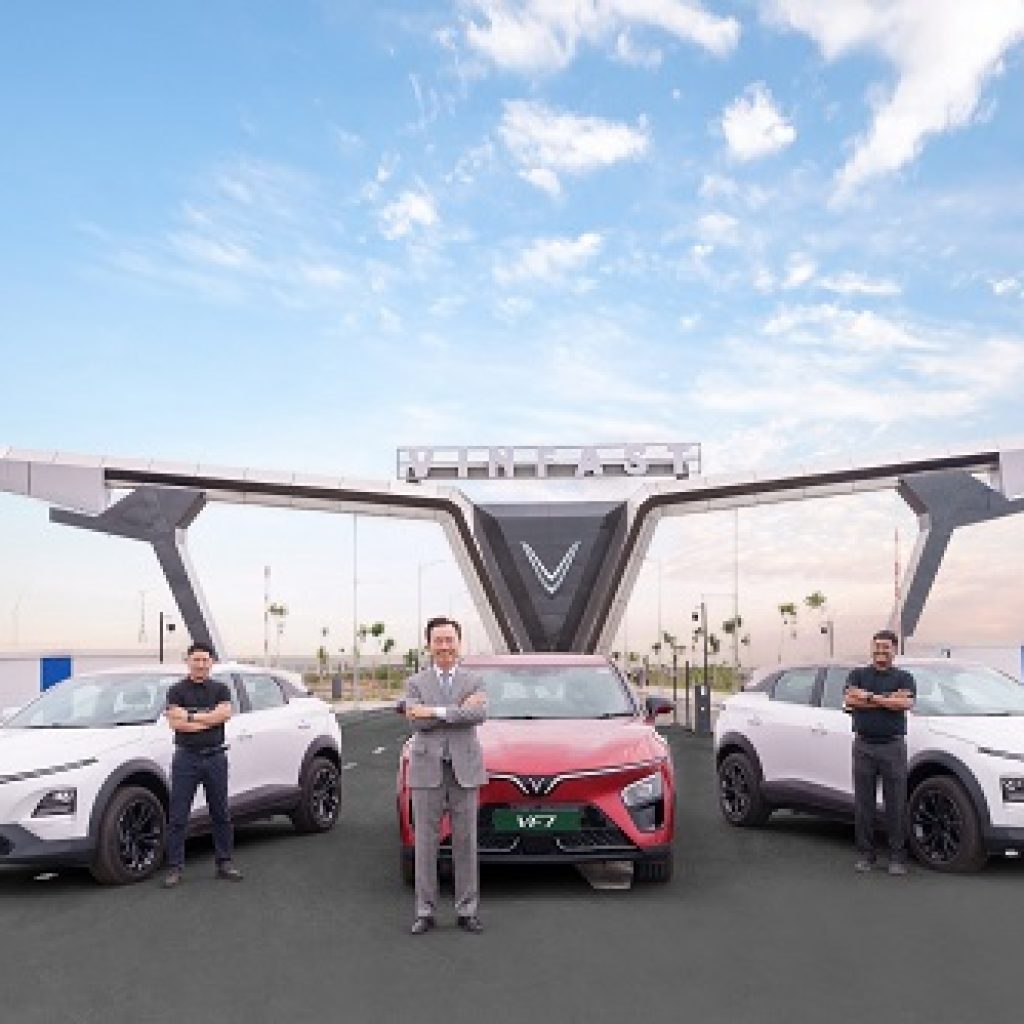
India is at the center of VinFast’s new global strategy. In February 2024, the company broke ground on its first India plant in Tamil Nadu, and by August 2025 it had officially inaugurated the facility in Thoothukudi. The site spans 400 acres with an initial capacity of 50,000 vehicles per year, scalable to 150,000, and is designed to serve both the domestic market and export routes.
VinFast has moved quickly to build customer-facing infrastructure. As of November 2025, the company already has 24 operational dealerships across key metropolitan and tier-one cities, with plans to reach 35 by the end of 2025. These showrooms introduce the premium VF 6 and VF 7, both of which have received strong early reception, including two major awards at the 2025 Jagran Hi-Tech Awards, where VinFast was named EV Manufacturer of the Year and the VF 7 received the EV Disruptor of the Year title.
Financing has also become a strategic pillar in India. In October 2025, VinFast signed a memorandum of understanding with YES BANK, India’s sixth-largest private-sector bank, to deliver retail and inventory-financing solutions for both customers and dealers. The partnership includes on-site bank representatives at every showroom, attractive interest rates, flexible repayment options, full on-road funding, and nationwide reach through YES BANK’s branch network. The aim of such a tie-up, not the first nor the last for VinFast India, is to lower barriers to EV ownership in a market where up-front cost remains a primary hesitation.
To address after-sales concerns, VinFast has partnered with service and charging-infrastructure providers including RoadGrid, myTVS, and Global Assure, creating a national maintenance and roadside-support backbone. It has also teamed up with BatX Energies to establish a circular battery-value chain and support advanced battery recycling, reinforcing India’s push toward sustainable electrification.
Charging infrastructure is expanding in parallel. V-Green is coordinating a multiyear plan to deploy a nationwide network in India similar to its rollout strategies in Vietnam and Indonesia. The objective is to ensure that the availability of public and semi-public charging keeps pace with the rising dealership footprint and the growth of VinFast’s fleet.
Each of these actions follows a consistent logic, combine manufacturing, charging, finance, and service under one coordinated framework, then scale. For VinFast, exporting cars is only part of the story. The larger aim is to export a vertically integrated mobility ecosystem, one that thrives where policy support, infrastructure rollout, and customer appetite align.
At home, Vietnam’s streets already show the results, quiet electric taxis replacing combustion fleets, chargers replacing fuel pumps, and consumers choosing local innovation over imports. Abroad, VinFast is applying the same playbook, pairing cars with infrastructure, financing, and service networks to make electric driving viable at scale.
But VinFast’s global push is not just about cars. It rests on the financial backing and broad ecosystem of Vingroup, and on Pham Nhat Vuong’s conviction that Vietnam can compete head-to-head with established automakers. His willingness to marshal resources across real estate, retail, energy, and technology has given VinFast the stability and integrated platform most young automakers lack. That combination, capital, ecosystem, and vision, is what sets VinFast apart.